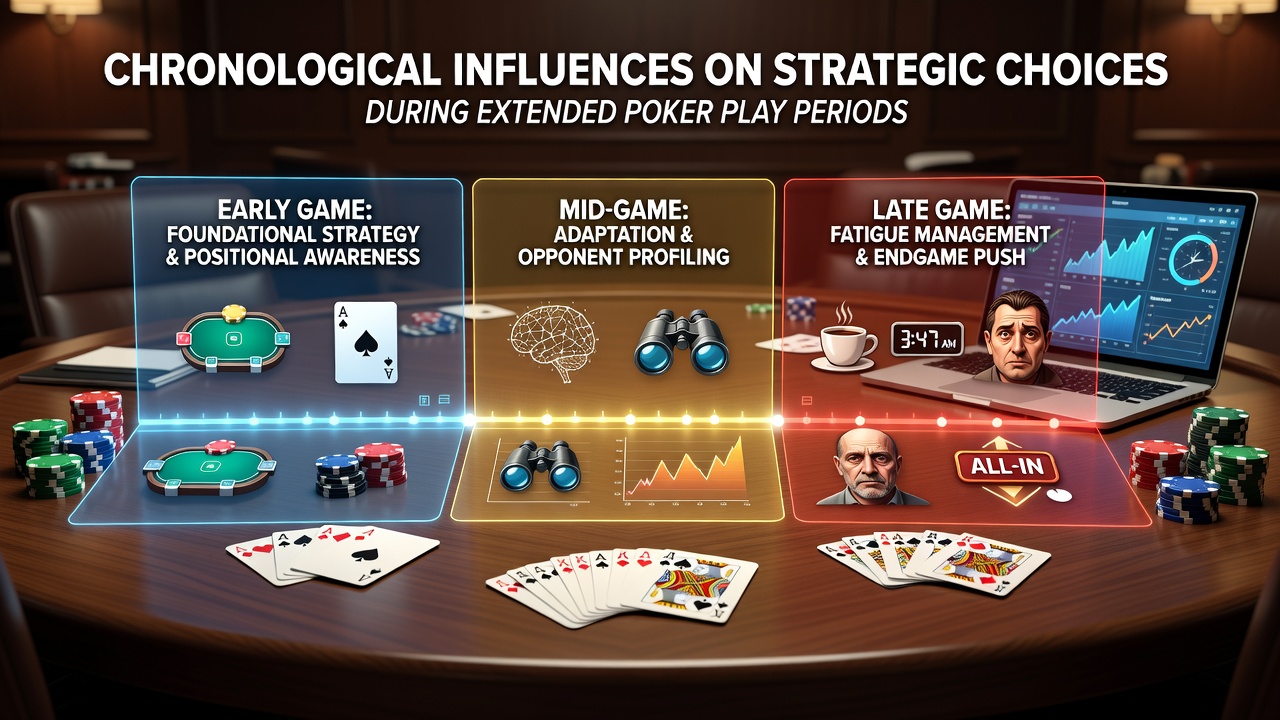
Time's Shadow Over the Felt: Chronological Patterns Shaping Poker Strategies in Long Sessions
Extended poker sessions stretch across many hours and the clock exerts measurable pressure on how players select actions, manage ranges, and adjust aggression levels. Research from cognitive science and gaming studies shows that decision quality shifts as sessions lengthen, with patterns emerging around session duration, time of day, and cumulative fatigue. Observers tracking professional circuits note that these chronological factors appear consistently across cash games and tournaments alike.
Circadian Rhythms and Early Versus Late Play Windows
Players who begin sessions in morning hours often demonstrate tighter opening ranges and more selective continuation betting compared with those who start after dark. Data collected from online poker platforms reveal that hand histories logged between 6 a.m. and noon contain fewer bluff attempts per 100 hands than equivalent samples recorded after midnight. Researchers attribute part of this variance to natural alertness cycles that peak for most adults in the late morning and early afternoon. In contrast, evening play coincides with elevated risk tolerance, evidenced by larger bet sizing in marginal spots during multiway pots.
Accumulating Fatigue Across Five-Hour and Ten-Hour Marks
Once a session passes the five-hour threshold, tracking software records a gradual rise in call frequency on river bets, particularly when players defend big blinds. Studies published in the Journal of Gambling Studies indicate that error rates in hand reading climb steadily between hours five and eight, then accelerate further beyond ten hours of continuous play. Those who continue past the ten-hour mark show measurable drops in fold equity realization because delayed reaction times reduce the precision of timing tells and bet sequencing. Professional circuits document similar trends during festival weeks when players grind multiple daily events.
Tournament Structures Versus Cash Game Endurance
Multi-day tournament formats introduce additional chronological layers because blind levels advance on fixed schedules regardless of individual fatigue. Players who reach day three or later often face decisions made after 12 or more hours of total play across consecutive days. Cash game participants retain the option to leave, yet data from major card rooms show that many regulars remain seated well past the point where performance metrics begin to decline. August 2026 festival schedules at several international venues overlapped with documented increases in average session length, producing observable shifts in pre-flop raise sizing during late-night hours.
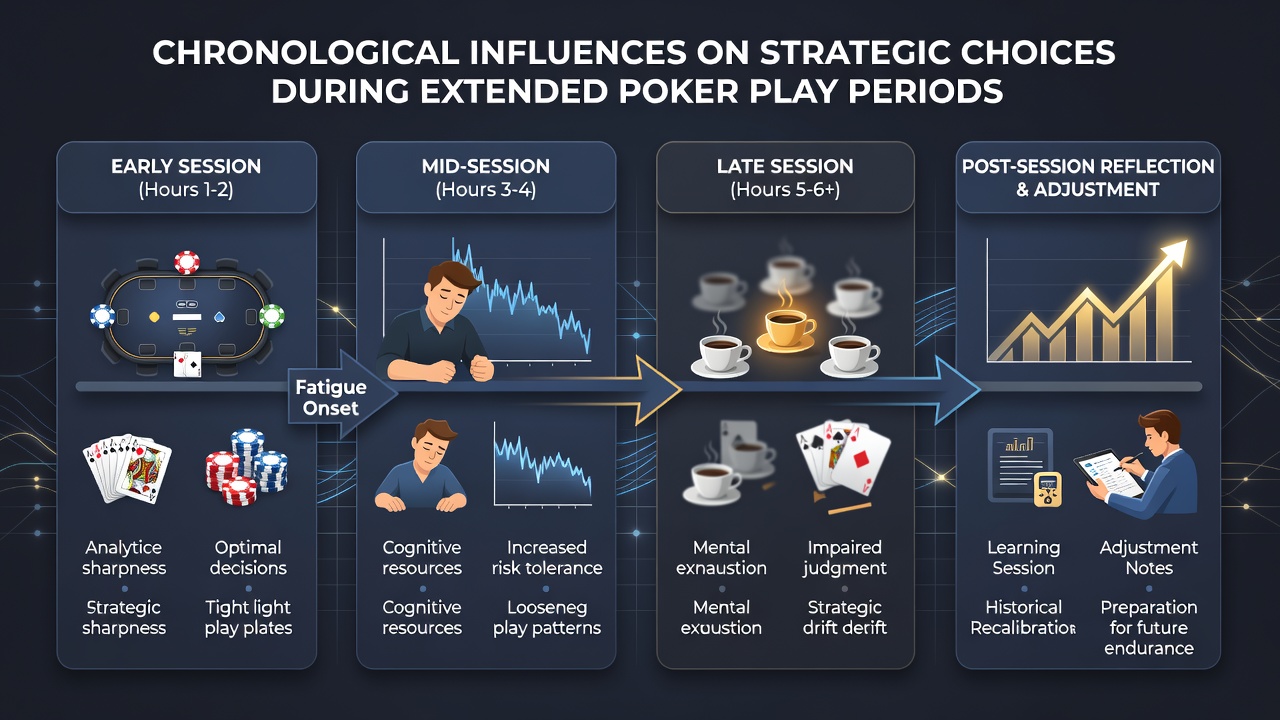
One study tracking European Poker Tour participants found that aggression factors dropped by roughly 12 percent between the start and end of day-long sessions, while passive calling ranges expanded. Cash game cohorts displayed comparable patterns once individual session times exceeded eight hours, although the magnitude varied by stake level and player age demographics.
Data Sources and Measurement Approaches
Investigators rely on hand-history databases, wearable sleep trackers, and reaction-time tests administered between breaks. Reports compiled by the Nevada Gaming Control Board include voluntary session-length disclosures that align with laboratory findings on sustained attention. Academic teams at institutions such as the University of Sydney have published peer-reviewed work examining how sleep debt accumulated across consecutive days correlates with increased variance in expected value calculations during heads-up play. These datasets collectively demonstrate that chronological variables produce consistent directional effects rather than random noise.
Strategic Adjustments Observed in Practice
Coaches and analysts report that successful long-session players insert scheduled breaks, alter caffeine intake timing, and rotate table selection to maintain decision speed. Some adopt shorter starting-hand matrices after hour six, reducing marginal opens in early position. Others track personal metrics such as voluntary put money in pot percentage and tighten river bluff frequencies once fatigue indicators appear. Tournament participants sometimes accelerate all-in shove ranges near the end of long days when stack preservation becomes secondary to survival through remaining levels.
Conclusion
Chronological influences on poker strategy emerge through measurable changes in aggression, range construction, and error frequency as time advances within a single session or across multiple days. Evidence drawn from hand databases, regulatory reports, and academic research confirms that these patterns hold across formats and regions. Players and researchers continue to examine how structured rest protocols and real-time monitoring tools can mitigate the documented effects of extended play duration.